Boiler Leaking Water? Westchester Guide
Learn what to do when a boiler leaks water, which observations are safe, what the leak location may indicate, and when Westchester homeowners need urgent help.
Published 2026-09-28 · Bravo Mechanical, Westchester County, NY
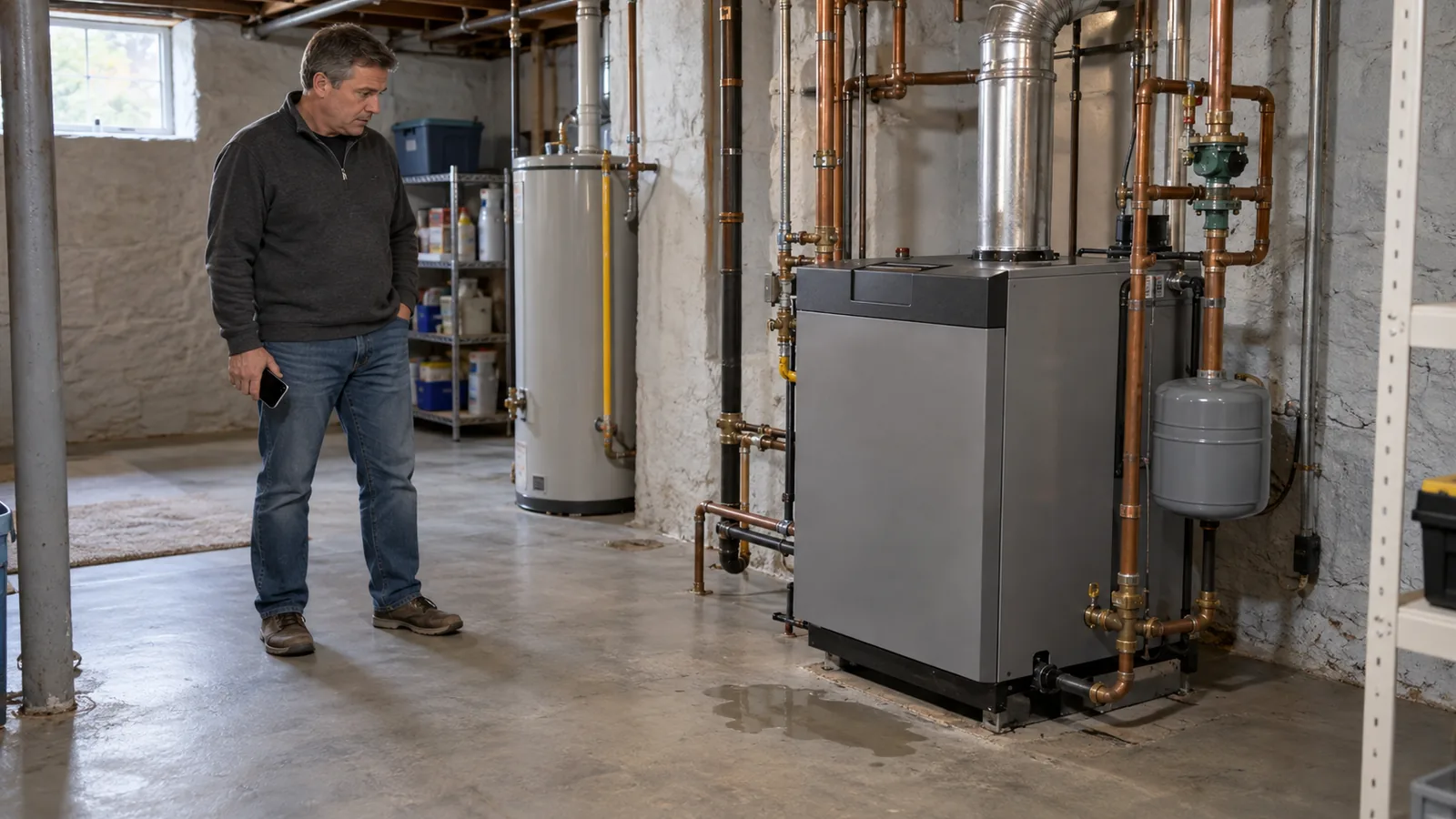
Quick answer: A leaking boiler needs prompt attention because the visible puddle does not reveal whether the source is a loose fitting, relief-valve discharge, condensate drain, pump seal, system pipe, or the boiler itself. Keep clear of hot water and electrical equipment, photograph the leak from a safe distance, note when it appears, and request professional diagnosis. Never plug a relief pipe or add leak-sealing chemicals.
First decide whether it is an emergency
Water on the floor is not automatically a fuel-gas leak, but a boiler combines hot water, electricity, pressure, and—on many systems—combustion. Leave the area and call 911 from outside if you smell gas, suspect a gas leak, see smoke or fire, hear electrical arcing, or a carbon monoxide alarm sounds. Do not operate switches, phones, flashlights, appliances, or vehicles inside or near an area where gas may be present.
Con Edison instructs customers with a gas or carbon monoxide emergency to leave immediately and call 911 or 1-800-752-6633. If your bill names another gas utility, use the emergency number printed on the bill after you are outside and safe. Carbon monoxide has no color, odor, or taste, so a CO alarm or possible symptoms require an emergency response—not boiler troubleshooting. See Con Edison's carbon monoxide guidance.
Keep everyone away if water is spraying, steaming, unusually hot, rapidly spreading, or approaching wiring, outlets, controls, or an electrical panel. Do not step into water to reach a switch or valve. For active sparking or fire, call 911. For a fast water leak without those life-safety signs, call for urgent boiler service and describe the rate and location of the leak.
What can you safely observe?
The useful homeowner role is to document, not disassemble. From a dry, stable location, record:
- Whether the boiler is hot-water, steam, or a combination boiler, if the label or manual makes that clear
- Whether water appears only while the boiler runs, after it stops, or even when it is cold
- The first visible wet point—not merely where water collects on the floor
- Whether the water is clear, rusty, or associated with white or green mineral deposits
- Any visible pressure or temperature reading without touching the gauge or opening a panel
- Thermostat messages or a factory display code visible from outside the cabinet
- New noises, loss of heat, repeated shutdowns, or recent service
Use photos or a short video if you can take them without approaching hot water or wet electrical equipment. Put a container or absorbent material near a slow drip only when it can be done without reaching under the boiler, blocking a drain, touching the equipment, or entering a wet electrical area. A container limits floor damage; it does not repair the cause.
Do not open the cabinet, remove insulation, tighten fittings, operate the relief-valve lever, drain or refill the system, bleed radiators, reset controls repeatedly, or add stop-leak products. Navien notes that homeowner troubleshooting is limited because boilers involve water, electricity, and gas and recommends qualified service for in-depth diagnosis.
Where is the boiler water coming from?
The first wet component gives a technician a starting point, but water can travel along a pipe or cabinet before dripping. These are diagnostic possibilities, not conclusions.
Relief-valve discharge pipe
A boiler relief valve is a safety device. Water at its discharge can result from a valve problem, excessive system pressure, or an expansion-control problem. The valve and its discharge path must never be capped, plugged, reduced, or redirected into an unsafe location.
U.S. Boiler Company's relief-valve safety guidance warns that a relief valve must never be plugged to stop a leak and explains why inspection belongs in professional maintenance. Hot discharge and unsafe pressure can cause severe injury or property damage. Your installed boiler may have different requirements, so its own manual and rating information control.
Automatic air vent, circulator, valve, or pipe joint
Hydronic systems use circulators, valves, air-removal components, fittings, and extensive piping. Seals can deteriorate, threaded or flanged joints can seep, and corrosion can develop around a recurring leak. A drip that appears at a pump or joint still needs the entire nearby piping path checked because water may be running from a higher point.
Expansion tank or automatic fill assembly
Hot-water systems need room for water to expand as it warms. A problem with the expansion tank, pressure-reducing fill valve, or related piping can change system pressure and contribute to relief-valve discharge. Do not add water based on a generic internet pressure number. Correct fill and operating pressure depend on the equipment, building height, system design, temperature, and manufacturer instructions.
Condensate on a high-efficiency boiler
A condensing boiler intentionally creates condensate while recovering heat from combustion gases. That water should follow an approved drain and, where specified, treatment arrangement. Water outside the intended drain path can come from a loose connection, blocked or damaged drain, failed pump, or another nearby source. Condensate is not proof that the boiler heat exchanger is leaking, but it should not be ignored.
Boiler section, heat exchanger, or internal component
Water emerging from the boiler cabinet, cast-iron sections, or an internal heat exchanger may indicate a more consequential failure. Do not remove a cover to confirm it. The technician should identify the exact source, evaluate the equipment's condition and serviceability, and determine whether repair is permitted and practical.
System piping, radiator, or an unrelated source
The puddle may begin outside the boiler. Check visually for an overhead domestic-water pipe, radiator or baseboard leak, floor drain backup, foundation seepage, water-heater leak, or dehumidifier discharge. If the nearby equipment is a storage water heater rather than the space-heating boiler, use our water-heater leak guide and follow the product-specific safety instructions.
Does the leak location tell you whether to repair or replace?
Not by itself. A serviceable external fitting is different from a leaking pressure vessel, but both can create the same puddle. A sound decision depends on the confirmed source, boiler type and age, corrosion, repair history, parts availability, safety, installation condition, and total written scope.
ENERGY STAR lists a boiler older than 15 years, frequent repairs, and rising energy bills as reasons to consider replacement—not automatic proof that replacement is required. Review those factors in our boiler repair-versus-replacement guide, then compare the actual diagnosis and written options.
Ask the technician to state:
- The exact source of water and how it was confirmed
- Whether the leak is external to the boiler or within the appliance
- What caused the leak, not just which wet part will be replaced
- Whether pressure, expansion, fill-water, circulation, combustion, or venting conditions contributed
- The repair scope, included parts, exclusions, and post-repair checks
- Any reason the boiler should remain off
- Whether another trade or the utility is required
What should professional diagnosis include?
The scope should match the equipment and symptoms. A qualified technician may examine the water path, system pressure cold and hot, expansion control, automatic fill, relief valve and discharge piping, circulators, vents, valves, heat exchanger or sections, condensate system, controls, combustion, venting, and visible distribution piping.
ENERGY STAR's heating-maintenance guidance calls for professional checks of controls, electrical connections, fuel connections, burner combustion, and the heat exchanger. The U.S. Department of Energy also identifies leak checks, relief and limit controls, expansion control, and heat-exchanger maintenance as part of boiler care. These are trained service tasks, not a homeowner checklist for opening the boiler.
After an approved repair, ask what was tested before the boiler returned to service. Depending on the system, that may include leak-free operation across a full heating cycle, stable pressure, correct control response, circulation, safe relief piping, condensate drainage, and combustion or venting checks.
Preventing repeat leaks without overpromising
Maintenance cannot prevent every gasket, casting, heat-exchanger, or piping failure. It can establish a baseline and identify seepage, corrosion, pressure change, relief discharge, drainage problems, or deteriorating components before a small issue becomes larger.
At the start of the heating season, look around the closed equipment and accessible piping for new moisture or deposits. Keep the boiler area clear, preserve access, and arrange equipment-specific maintenance using the installed manufacturer's schedule. Our Westchester boiler tune-up checklist explains what to ask for without turning safety checks into do-it-yourself work.
Request boiler-leak diagnosis in Westchester County
If you see water around a boiler, use the safety screen above and request diagnosis before continued operation. Visit boiler repair in Westchester County or call (914) 361-9142 with the boiler type, visible leak location, rate, pressure reading if safely visible, and any loss of heat or fault code. For a fast leak or urgent no-heat condition after the property is safe, use the emergency HVAC repair page. Dispatch timing depends on location, weather, call volume, and technician availability.
Frequently asked questions
Can I keep using a boiler that has a small leak?
A small visible drip does not reveal the cause or how quickly it may worsen. Request prompt diagnosis and follow the installed manufacturer's shutdown guidance. Keep the boiler off when a technician, utility, emergency responder, or product manual directs it, or when water, electrical, combustion, or pressure conditions may be unsafe.
Should I add water when the boiler pressure is low?
Do not refill from a generic online instruction. Low pressure may be related to a leak or another fault, and the correct fill procedure and pressure depend on the system. Record a safely visible gauge reading and ask a qualified technician to diagnose the loss.
Why is water coming from the boiler relief pipe?
Possible reasons include a relief-valve problem, excessive system pressure, an expansion-tank issue, or a fill-control problem. Never plug the pipe or assume replacing the valve alone fixes the cause. The valve, pressure behavior, expansion control, and fill arrangement need evaluation.
Could the water be normal condensate?
Condensing boilers create water during normal operation, but it should travel through the intended drain system. Water outside that path can indicate a drain, connection, pump, or appliance problem. Have the source confirmed rather than treating any puddle as normal.
When is a boiler leak an emergency?
Leave and call 911 from outside for a gas odor or suspected gas leak, carbon monoxide alarm or possible CO symptoms, smoke, fire, or active electrical arcing. Keep clear of spraying or scalding water and water near live electrical equipment. A fast leak without those signs still warrants an urgent service request.
Request service or an estimate or call (914) 361-9142. Serving 34 listed communities in Westchester County, NY.