MERV 8 vs. 11 vs. 13 Filters in Westchester
Choose an HVAC filter by MERV rating, fit, and system compatibility. Compare MERV 8, 11, and 13 and learn what to ask before upgrading filtration.
Published 2026-09-09 · Bravo Mechanical, Westchester County, NY
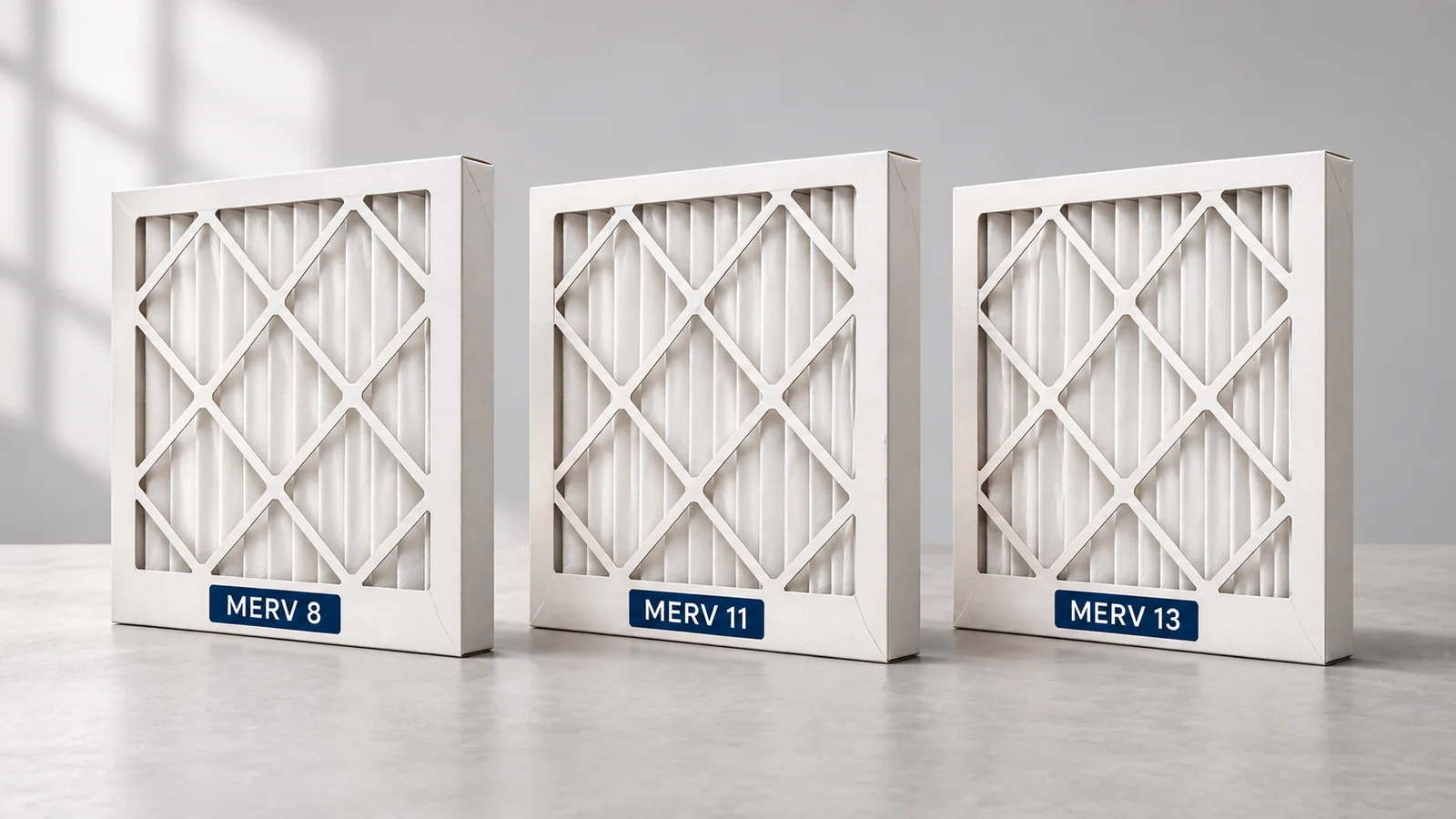
Quick answer: Choose a filter that fits correctly and provides the highest particle-removal efficiency your HVAC system can accommodate. MERV 13 captures smaller tested particles more effectively than MERV 8 or 11, but the rating alone does not establish compatibility with your fan, filter cabinet, or duct system. Check the equipment guidance and ask an HVAC professional before making an uncertain upgrade. A filter is not a remedy for a gas leak, carbon monoxide, or the source of a moisture problem.
Buying an air filter looks simple until the shelf offers several sizes, thicknesses, and competing ratings. A Westchester homeowner might also have more than one type of equipment: a central AC system, a furnace, a boiler, or ductless units. The right starting point is identifying which piece of equipment moves air through the filter you are replacing.
This guide is a selection and maintenance checklist. It helps you ask useful questions without treating a filter rating as a diagnosis of indoor air quality or an automatic improvement for every system.
What the MERV number tells you
MERV stands for Minimum Efficiency Reporting Value. EPA's explanation of MERV ratings describes how the rating compares capture of particles in specified size ranges. Higher ratings represent stronger performance in the tested ranges; they do not mean that every pollutant is removed.
For the three common choices below, EPA reports these minimum average capture efficiencies:
Filter rating 0.3–1 micron particles 1–3 micron particles 3–10 micron particles
--- --- --- ---
MERV 8 No minimum listed in EPA's table At least 20% At least 70%
MERV 11 At least 20% At least 65% At least 85%
MERV 13 At least 50% At least 85% At least 90%
These are filter-test comparisons, not promised reductions throughout your home. The amount of air passing through a properly installed filter, operating time, fit, and ongoing pollutant sources all matter. “No minimum listed” also does not mean the filter captures zero particles in that range.
Why the highest number is not the entire decision
Ask two questions together: “How well does this filter capture particles?” and “Can my system operate appropriately with this specific filter installed?” The first concerns filtration. The second concerns the equipment and airflow.
EPA recommends MERV 13, or the highest rating the system fan and filter slot can accommodate. If compatibility is unclear, an HVAC professional can evaluate the system and recommend a suitable filter or a different filter arrangement.
When requesting that evaluation, ask the technician to identify the equipment guidance and the actual filter model being considered. A useful recommendation should specify size, thickness, rating, and any installation limitation. “Use a better filter” is too vague to help you shop confidently the next time.
Avoid a universal claim that every one-inch MERV 13 filter is unsuitable, or that every HVAC system accepts one without evaluation. Ask for an answer tied to your equipment and the selected product.
Confirm size and fit before changing ratings
Start with the label on the current filter and the equipment's instructions, but do not assume the previous filter was correct. Write down the length, width, thickness, and any part number. If the cabinet label or manual names an approved replacement, keep that information with your maintenance notes.
Ask about nominal versus actual dimensions if a replacement package appears to describe a similar but not identical size. Do not bend, crush, trim, or stack filters to make them fit. EPA's air-cleaner guide advises a snug fit so air does not bypass the filter.
Follow the equipment instructions for orientation and access. A service-access panel and a homeowner-accessible filter slot are not necessarily the same thing. If replacing the filter requires opening equipment you do not understand, ask a technician to demonstrate the intended procedure.
For your next purchase, keep a photo of the correct package and a note identifying the unit it serves. In a home with multiple air handlers, labeling each filter location helps prevent buying the right product for the wrong system.
Does this advice apply to boilers and mini-splits?
A boiler that distributes heat through radiators or hot-water baseboard does not use a central forced-air filter to heat those rooms. You may still have a separate central air-conditioning or ventilation system with its own filtration requirements. Identify the equipment before ordering a “furnace filter” for a boiler-heated home.
Ductless indoor units have manufacturer-specific filters and maintenance instructions. Do not insert generic central-HVAC filter media into them as an improvised upgrade. Ask which parts are intended for owner maintenance and which tasks require service.
If you have boiler heat and no central air-distribution system, tell the contractor that when asking about indoor air quality. The discussion may concern a room air cleaner or ventilation rather than a central filter cabinet. The right question is where and how filtration could operate in your existing home.
How often should you check or replace the filter?
ENERGY STAR recommends inspecting, cleaning, or changing HVAC filters monthly. Use that as a reminder to check the manufacturer's instructions and the condition of the filter; it is not permission to wash a disposable filter or ignore a product-specific service interval.
Make the schedule easy to maintain:
1. Record the installation date and exact replacement product. 2. Set a recurring reminder to check the filter using the instructed procedure. 3. Replace or maintain it according to the equipment and filter guidance. 4. Note whether it is becoming dirty sooner than expected. 5. Ask for service if you cannot access it safely or have concerns about system operation.
Tell the technician about renovation dust, pets, extended operating periods, or other changes since the last service visit. Those details give context for a maintenance recommendation. Do not assume a filter's advertised maximum life applies equally to every home.
ENERGY STAR also notes that dirty filters can increase energy costs and damage equipment. Keeping a compatible filter maintained is part of HVAC care, not simply a choice about how much dust you see on furniture.
What if airflow seems weaker after a filter change?
Write down when the change occurred, the product installed, and the symptom. Report whether the issue affects all supply vents or only one room, and whether the system is heating or cooling when you notice it. This information helps a technician investigate without assuming the filter is the only possible cause.
Do not compensate by removing filtration and continuing normal operation, adding a second filter, changing blower settings, or opening electrical compartments. Follow the equipment's shutdown guidance if a fault develops and request professional assessment. If the filter is visibly misfitted and you can safely use the documented homeowner replacement procedure, correct the fit with the specified product; otherwise leave the correction to the technician.
For a broader maintenance discussion, see Bravo's Westchester HVAC maintenance checklist. When booking, describe the new symptom separately from the routine filter change so the visit can address it directly.
When a room air cleaner is worth discussing
Sometimes the immediate question concerns one occupied room, or the home lacks central forced-air equipment. In that case, a portable air cleaner may be a useful topic to discuss alongside source control and ventilation.
EPA explains that clean air delivery rate, or CADR, helps match a portable cleaner's particle-removal capacity to the room. Check the product's room-size guidance and consider the noise at the speed you would actually use. A unit left off because it is too loud will not provide the intended filtration.
List your practical requirements before comparing products: room size, placement, replacement-filter availability, operating sound, and maintenance. This article does not endorse a particular brand or guarantee a health outcome. It also does not treat a room cleaner as a replacement for investigating an ongoing source of contamination.
Filtration does not replace source control
An ongoing indoor-air complaint deserves a description more specific than “bad air.” Note whether you are seeing dust, noticing an odor, observing condensation, or dealing with an identified moisture source. Record where it occurs and whether it changes with equipment operation. Avoid assigning a cause from odor alone.
EPA's indoor-air-quality guidance identifies source control, ventilation, and air cleaning as distinct approaches. A more efficient particle filter cannot repair a water leak or eliminate the reason a building stays damp. Ask for the underlying issue to be evaluated rather than repeatedly buying more expensive filters.
If there is a suspected gas leak, leave immediately and call 911 or the utility from a safe location. If a CO alarm sounds, leave and call 911 from outside. Do not wait for a filter change, an air cleaner, or an HVAC appointment to address an emergency. Con Edison's safety contact guidance distinguishes these emergencies from ordinary service requests.
For a broader overview of equipment options, see indoor air quality solutions for Mamaroneck homes. Filter compatibility remains a separate, equipment-specific question.
Questions to ask at your next HVAC visit
- Which filter location serves each part of the home?
- What exact dimensions and replacement product should I use?
- What is the highest appropriate filtration level for this setup?
- Would a proposed upgrade require changes to the filter cabinet or system?
- How should I perform the approved homeowner maintenance procedure?
- Which operating symptoms should prompt a service call?
- Is my concern about particles, ventilation, moisture, or something that needs a different assessment?
Ask for the answers in your service notes. That creates a practical purchasing and maintenance reference instead of relying on memory when the next replacement is due.
Frequently asked questions
Is MERV 13 better than MERV 8?
It provides stronger capture in the tested particle-size ranges, especially for smaller particles. It is the better selection for your system only when the specific filter and installation are compatible with the equipment.
Can I put two filters in one slot?
Do not stack filters unless the equipment manufacturer explicitly specifies that arrangement. Use the approved filter configuration and ask a professional if the fit or intended setup is unclear.
Should I buy the thickest filter available?
Choose the thickness designed for the cabinet. A thicker filter requires a compatible installation; it should not be forced into a slot or substituted based on thickness alone.
Will a new filter fix a musty smell?
A persistent odor needs investigation of its source. A filter change is not evidence that a moisture or other building problem has been resolved. Describe the location and timing of the odor when requesting an assessment.
Get help choosing a compatible filter
Contact Bravo Mechanical or call (914) 361-9142 to discuss HVAC maintenance or an indoor-air-quality concern in Westchester County. Have your equipment type, current filter information, and any operating symptoms ready. You can also review our HVAC services and confirm availability for your address when booking.
Request service or an estimate or call (914) 361-9142. Serving 34 listed communities in Westchester County, NY.