Westchester Furnace Blowing Cold Air?
Learn why a furnace may run without producing warm air, which checks Westchester homeowners can make safely, and when to stop and call for repair.
Published 2026-09-14 · Bravo Mechanical, Westchester County, NY
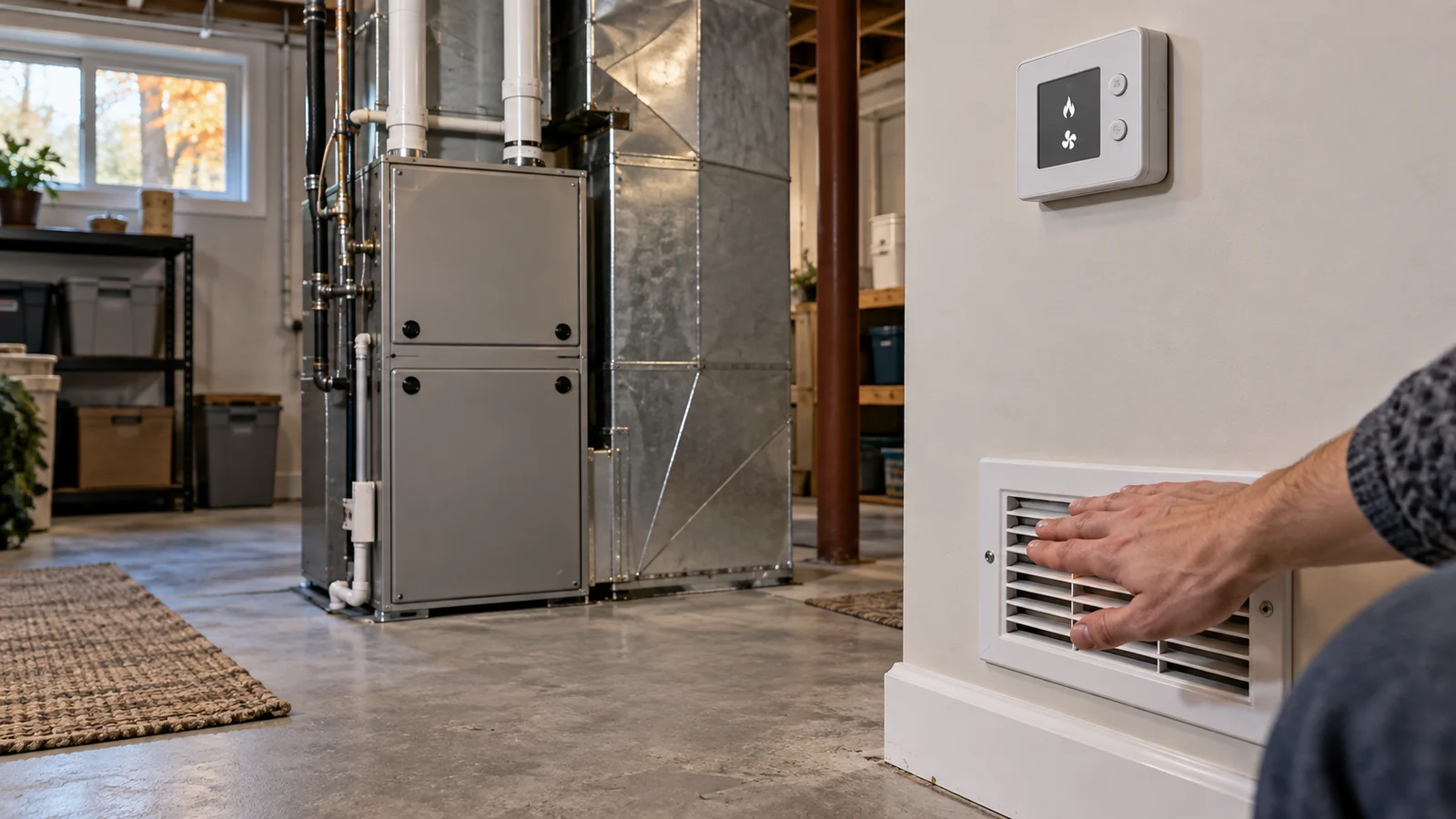
Quick answer: If your furnace is blowing cool air, confirm the thermostat is on Heat, the setpoint is above room temperature, and the fan is on Auto. Check an accessible filter and clear supply and return grilles. A brief startup or cool-down period can be normal on some systems; persistent cool air, falling temperature, weak airflow, or repeated restarts needs professional diagnosis.
Check for an emergency before troubleshooting
Leave the building and call 911 from outside if a carbon monoxide alarm sounds, anyone may have carbon monoxide symptoms, you see smoke or fire, or you suspect a gas leak. If you smell gas, do not use switches, phones, flashlights, appliances, or a vehicle inside or near the affected area. Con Edison instructs customers to leave first and then call 911 or 1-800-752-6633 from a safe location. If your gas bill shows a different utility, use the emergency number printed on that bill after you are outside and safe.
Carbon monoxide has no color, odor, or taste. Headache, dizziness, nausea, chest tightness, fatigue, or fainting can be warning signs, but an alarm or symptoms require an emergency response—not HVAC troubleshooting. See current guidance from Con Edison on gas leaks and carbon monoxide safety.
If there is no immediate safety concern, the observations below can help you decide whether the issue is a simple setting or a repair call. They cannot prove that a furnace is safe or identify a failed component.
What does “cold air” from a furnace mean?
Air from a heating register can feel less warm than expected without being outdoor-cold. The important questions are when it happens, how long it continues, and whether the room temperature is rising.
Some furnaces delay the blower while the heat exchanger warms. The blower may also run briefly after the burners stop so the equipment can cool. The exact sequence and timing are model-specific; use the operating description in the furnace or thermostat manual rather than a universal number of minutes. Trane's furnace limit-switch guidance explains that heat delivery is not instantaneous and that safety controls manage burner and blower operation.
Persistent room-temperature air is different. It can mean the thermostat is commanding the fan without heat, heating is being interrupted by a safety control, the furnace is not completing ignition, airflow is restricted, or the duct system is not delivering the heated air as intended. Those are possibilities, not a diagnosis.
Five safe checks you can make
Only do these checks when there is no gas odor, carbon monoxide alarm, smoke, fire, sparking, or strong electrical smell.
1. Confirm thermostat mode, setpoint, and fan setting
Set the thermostat to Heat and place the set temperature above the displayed room temperature. Choose Auto for the fan unless your equipment or indoor-air-quality setup specifically requires another setting. With the fan set to On, the blower can circulate room-temperature air between heating cycles, which may feel like the furnace is producing cold air.
If the thermostat uses a schedule, check that the active period did not change after a power interruption or programming update. Do not remove thermostat wiring or jump terminals.
2. Observe one normal cycle from the living space
Listen from outside the equipment area and note what happens: thermostat calls for heat, the furnace begins its sequence, warm air reaches the registers, and the system later shuts down. Manufacturer sequences vary, so stop if you hear repeated clicking, banging, buzzing, or rapid restarts. Do not repeatedly raise and lower the setpoint to force more ignition attempts.
3. Check an accessible air filter
If the filter is in a familiar, homeowner-accessible slot, compare its size and orientation with the label or owner's manual. Replace a visibly dirty filter with the specified size and an appropriate filter type. Never run the furnace without a filter, force a filter into the rack, or open a furnace cabinet to reach an unfamiliar location.
A loaded filter can restrict airflow. A furnace may then stop the burners on a temperature safety limit while the blower continues to cool the equipment, producing air that feels cool. ENERGY STAR's maintenance checklist recommends regular filter inspection and identifies airflow, controls, combustion, and the heat exchanger as maintenance items.
Filter choice matters as well as cleanliness. A higher MERV number is not automatically better for every system. Use the equipment and filter-rack guidance, or see our Westchester air-filter guide before changing filter type.
4. Look for blocked supply registers and return grilles
Open normal supply registers and move furniture, rugs, curtains, and stored items away from both supplies and returns. Do not remove grilles, reach into ductwork, or close multiple vents to redirect heat. Restricted airflow can contribute to overheating and safety-limit operation, while duct leakage or distribution problems can make delivered air feel cooler in certain rooms.
5. Record visible information without opening the furnace
Write down the thermostat settings, approximate outdoor and indoor conditions, whether airflow is weak or normal, which rooms are affected, and what the system sounds like. If a fault code is visible through a factory sight glass or on the thermostat, photograph or record it. Do not remove a panel to find a control board or code label.
Common causes a technician may investigate
Cool air between otherwise normal heating cycles
The thermostat fan may be set to On, or the equipment may have a model-specific blower delay. Settings and normal sequences vary by thermostat and furnace.
Warm air starts, then turns cool while the blower keeps running
Restricted airflow or a temperature-limit response may be involved. The cause could be the filter, blower, duct system, setup, or a safety control. Never bypass or reset a limit switch.
The furnace starts repeatedly but does not stay heating
An ignition, flame-proving, fuel, venting, or control problem may be interrupting the cycle. Fuel, combustion, and electrical testing require training and instruments.
Airflow is weak throughout the home
The filter, blower, return-air path, supply-air path, or duct system may be restricted. A correct repair depends on measured airflow and the equipment's approved operating range.
Only one area stays cold
A register, damper, duct leak, balancing problem, or building-envelope issue may be involved. The furnace may be producing heat even though it is not reaching that space effectively.
A high-efficiency furnace stops and water is present nearby
Applicable equipment may have a condensate or drainage issue. The water source and shutdown logic are equipment-specific; internal drains and switches should not be bypassed.
These symptoms overlap. For example, cool air alone does not establish that a heat exchanger is cracked, a flame sensor is dirty, or a limit switch has failed. Carrier's furnace troubleshooting overview describes several different conditions that can interrupt heat while the blower still operates.
When to stop and request furnace repair
Call for professional service when:
- Air stays cool after the thermostat, fan, filter, and grille checks
- The indoor temperature continues to fall
- The furnace starts and stops repeatedly or fails to complete a normal cycle
- A breaker trips more than once, a fuse opens again, or the thermostat repeatedly reports a fault
- Airflow is unusually weak, the blower runs continuously, or there are new mechanical or electrical noises
- Water appears near a high-efficiency furnace
- Soot, scorch marks, damaged venting, or unusual odors are visible from outside the closed equipment
- You are unsure whether the behavior is normal for the installed system
Do not open burner or blower panels, clean a flame sensor, relight equipment unless the furnace manufacturer explicitly assigns that procedure to the homeowner, adjust a gas valve, probe electrical components, clear internal condensate parts, bypass a switch, or repeatedly reset the furnace or breaker. Keep the system off if an electrical or combustion concern is possible.
For a no-heat condition without an immediate gas, carbon monoxide, smoke, or fire emergency, use the emergency HVAC repair page after the property is safe.
What information helps the service call?
Before requesting service, collect what you can without opening the equipment:
- Furnace fuel type and approximate age, if known
- Thermostat mode, fan setting, set temperature, and displayed room temperature
- Whether the issue affects every register or one area
- Whether airflow is normal, weak, continuous, or intermittent
- When the filter was last changed and the size shown on the current filter
- Visible thermostat messages or factory-display codes
- Any recent power interruption, thermostat change, maintenance, or construction
- New odors, sounds, water, or repeated shutdowns
This history helps a technician reproduce the symptom and choose the right diagnostic path. A qualified visit may include equipment-specific electrical, control, ignition, combustion, temperature-rise, airflow, venting, and duct checks. The work should follow the furnace manufacturer's instructions and the conditions found on site.
Can maintenance help prevent cold-air complaints?
Maintenance cannot prevent every failure, but it can identify a loaded filter, blocked airflow, control-sequence concern, drainage issue, or deteriorating component before peak heating demand. ENERGY STAR recommends a professional pre-season heating check and calls out thermostat operation, electrical connections, controls, airflow, fuel connections, burner combustion, and the heat exchanger.
Use the schedule and tasks specified for your equipment rather than assuming every furnace needs the same service interval. Our HVAC maintenance page explains how to confirm a project-specific scope. Related symptoms may also be covered in our guides to furnace short cycling, a furnace that will not ignite, and furnace burning odors.
Request furnace help in Westchester County
If the safe checks do not restore normal heat, visit furnace repair in Westchester County or call (914) 361-9142 to describe the symptoms and confirm current availability for the service address. Dispatch timing depends on location, weather, call volume, and technician availability.
Frequently asked questions
Why is my furnace blowing cold air when the heat is on?
The fan may be set to On, the blower may be in a model-specific startup or cool-down period, airflow may be restricted, or heating may have stopped during ignition or safety-control operation. Check Heat, setpoint, Fan Auto, an accessible filter, and unblocked grilles. Persistent cool air requires diagnosis.
Is a short burst of cool air at furnace startup normal?
It can be normal on some systems while the furnace completes its startup sequence, but the timing is model-specific. Check the owner's manual. If air stays cool, the room temperature falls, or the furnace repeatedly restarts, request service.
Can a dirty filter make a furnace blow cold air?
Yes, a loaded filter can restrict airflow. On some furnaces, a temperature safety control can stop the burners while the blower continues. Replace only a familiar, accessible filter with the correct size and type; continued symptoms need professional evaluation.
Should I reset the furnace if it is blowing cold air?
Do not repeatedly reset the furnace, breaker, or a safety switch. One trip or fault may signal a condition that needs diagnosis, and a second trip is a reason to leave the system off and call a professional. Never bypass a limit or safety device.
When is cold air from a furnace an emergency?
Cool air alone is usually a repair symptom, not proof of an emergency. Leave and call 911 from outside for a gas odor or suspected leak, a carbon monoxide alarm or symptoms, smoke, or fire. After authorities or the utility say the property is safe, an HVAC company can address the equipment.
Request service or an estimate or call (914) 361-9142. Serving 34 listed communities in Westchester County, NY.