Heat Pump AUX vs. Emergency Heat
Learn what AUX and Emergency Heat mean, which heat-pump observations are safe, and when Westchester homeowners should request professional service.
Published 2026-09-30 · Bravo Mechanical, Westchester County, NY
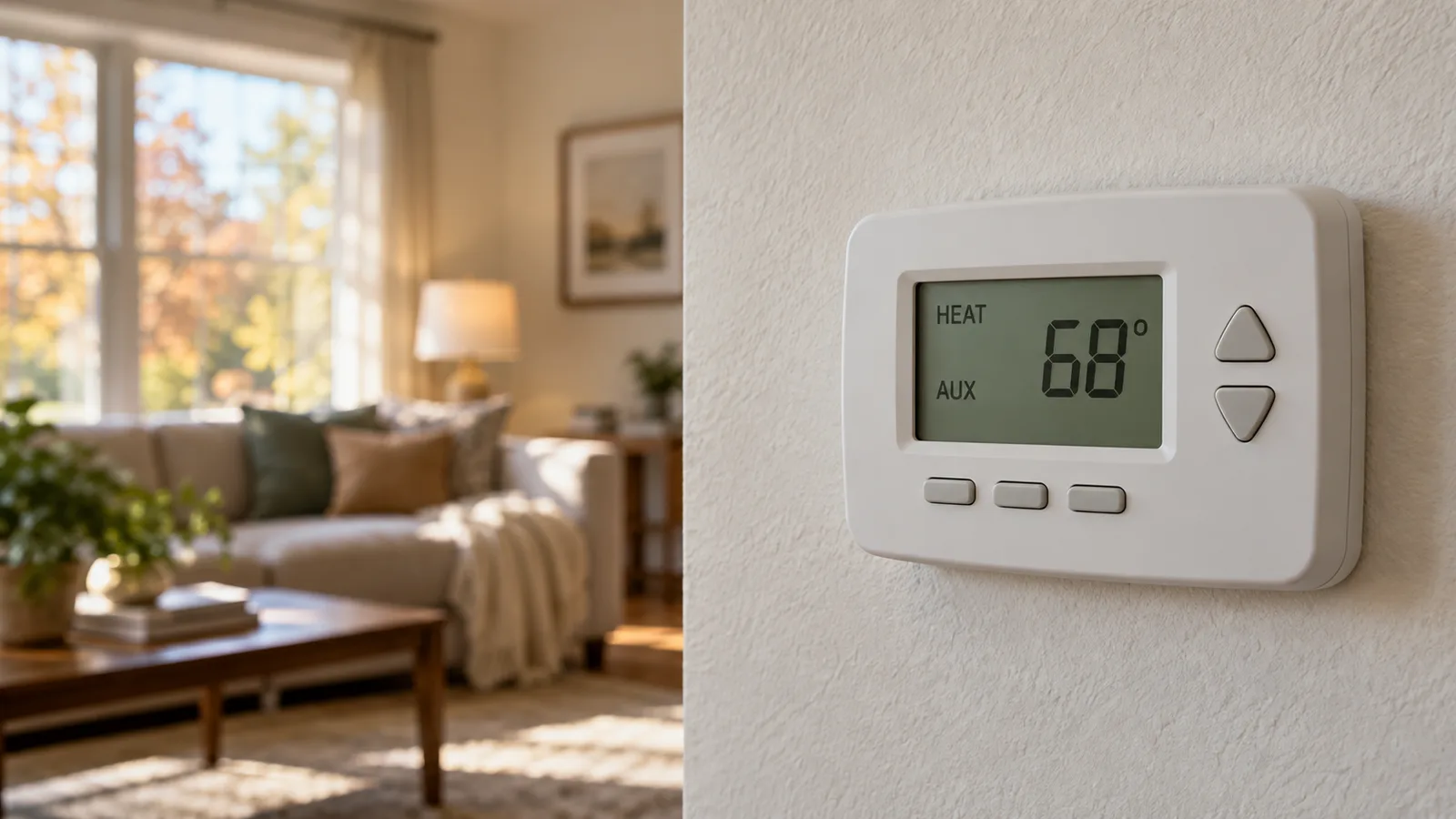
Quick answer: AUX usually means your heat-pump controls have automatically requested supplemental heat. Emergency Heat is a separate mode on some systems that uses backup heat instead of the compressor. An AUX message alone does not prove a breakdown. Check the room temperature, recent schedule changes, and the equipment instructions; request service if comfort is falling, an alert appears, or operation differs from the documented setup. Do not change installer settings to silence the message.
Start with the system you actually have
Before comparing thermostat labels, identify the heating equipment from your owner's documents or a safely visible exterior label. A heat pump paired with electric resistance heaters behaves differently from a dual-fuel system with a furnace. A ductless unit may not have integrated backup heat or an Emergency Heat option at all. Separate baseboard heaters or a boiler do not automatically become controlled backup just because a heat pump is installed nearby.
For a Westchester home with more than one heating system, write down which thermostat controls which rooms and equipment. If that relationship is unclear, ask the installer or service technician to explain it. Do not test your theory by switching off equipment or changing hidden menus. A useful handover includes normal display messages, expected seasonal operation, and instructions for reporting a problem.
AUX and Emergency Heat are not interchangeable
The following comparison describes common arrangements, not every manufacturer's control sequence. Use the installed equipment and thermostat manuals for your system.
Display or mode What it commonly means Appropriate owner response
--- --- ---
Heat, without AUX The controls are calling for ordinary heating Observe comfort and follow the normal schedule
AUX or auxiliary heat Supplemental heat has been requested automatically Note when it appears and whether temperature recovers
Emergency Heat or EM Heat A supported backup-only mode that typically stops compressor heating Use only under equipment-specific guidance for a malfunction and arrange service
Fault, service message, or an unfamiliar symbol A condition requiring model-specific interpretation Record the exact message; consult the manual or service provider
Trane's AUX and Emergency Heat guidance illustrates how labels and configured stages vary, and assigns auxiliary-heat configuration to HVAC professionals. A display is a clue, not a complete diagnosis. In particular, seeing AUX does not tell you the fuel type or prove that every requested component is actually producing heat.
Why AUX may appear during normal operation
Supplemental heat may be called when demand exceeds what the heat pump is supplying, while recovering from a substantial temperature change, or during a defrost cycle. Depending on the equipment and controls, backup may supplement the compressor or take over. Do not assume that a furnace and compressor should always run together.
Carrier explains that there is no universal AUX activation temperature. Equipment capacity, the home's heating demand, and control configuration matter. An outdoor reading of 35°F or 40°F is therefore not a reliable pass/fail test for every installation. Likewise, one home's thermostat behavior is not a specification for the house next door.
Defrost is another reason a single observation can mislead. Supplemental heat can help maintain comfort while an air-source heat pump manages outdoor-coil frost. But AUX alone does not confirm that defrost is occurring. Record the sequence rather than concluding that any long AUX period is normal defrost—or that any pause is a failed compressor.
Should you select Emergency Heat when it gets cold?
Not simply because outdoor temperature drops. On systems that provide it, Emergency Heat is generally intended for a heat-pump malfunction, using available backup heat while the compressor is out of service. It is not a routine “extra powerful” heating setting. Trane describes this distinction and advises arranging HVAC service when emergency operation is needed.
If the home is losing heat, call with the model, display message, and indoor temperature. Ask whether the installed backup is safe and suitable to use, and follow the specific instructions you receive. Do not assume an Emergency Heat selection guarantees heat, works during a power outage, or makes a damaged system safe. If no backup was installed or configured, a menu label cannot create it.
A safe observation checklist before calling
Gather information without opening equipment or touching wiring. These details help the person taking your service request distinguish a controls question from a loss-of-heat problem:
1. Photograph the display. Include the room temperature, requested temperature, operating mode, and exact alert or symbol. Avoid sharing account details from a connected app. 2. Record the timing. Did AUX appear after a scheduled morning warm-up, a manual temperature change, a power interruption, or a recent thermostat replacement? 3. Describe comfort. Is the displayed temperature moving toward the setting, staying stable, or continuing to fall? Are all rooms affected, or only a particular zone? 4. Note accessible airflow obstructions. Look for furniture covering return grilles or supply registers. Do not remove equipment panels or reach into a blower compartment. 5. Review routine filter care. Follow your manual only for a filter explicitly intended for owner access. If access requires equipment-opening, unfamiliar shutdown steps, or unsafe footing, leave it for the technician. 6. Observe outside from a safe location. Describe visible snow, heavy ice, damage, unusual sound, or blocked clearance. Do not chip ice, pour hot water on the unit, remove guards, or touch the fan.
There is no need to repeatedly raise the setting to see whether more stages start. Also avoid breaker resets, disconnect operation, rewiring, refrigerant work, or disabling a backup stage. Those actions can hide the original symptom or introduce a new hazard.
When to request service—and when to leave first
Request professional help when AUX behavior changes markedly from the documented setup, the home cannot maintain temperature, a fault appears, or repeated cycling accompanies poor comfort. Persistent heavy ice, unusual mechanical noise, or a damaged outdoor unit also warrants evaluation. Do not use a generic internet runtime limit to decide how long an uncomfortable or unsafe condition is acceptable.
An unexpected bill is a reason to review operation, but not proof that a particular component failed. Compare the billing period, weather, occupied hours, and thermostat schedule, then provide available equipment runtime information. Avoid disabling necessary heat as a cost experiment.
For a suspected gas leak, gas odor, carbon monoxide alarm, smoke, fire, or active electrical arcing, leave the area and get everyone to safety before calling 911. For suspected gas, do not operate switches, appliances, or a phone near the suspected leak. Con Edison's gas-safety guidance directs people to leave first and call from safety; contact your gas utility as appropriate. A thermostat's Emergency Heat mode is not a response to a life-safety emergency.
What a professional should explain about the controls
Ask for a plain-language description of what runs under normal heating, recovery, defrost, and backup operation. The DOE-hosted CEE homeowner guide to two-system controls recommends asking how the systems are controlled and how to recognize intended operation. It also identifies frequent cycling, excessive secondary heat, and comfort problems as reasons to consult the contractor.
A useful service discussion includes:
- Which backup source is installed and which rooms it can serve
- Whether the controls supplement the heat pump or switch between heat sources
- What the current lockouts and staging settings are intended to accomplish
- Whether a changed thermostat or schedule affected operation
- What observations or measurements support the diagnosis
- What was checked after any repair or adjustment
The inspection scope depends on the equipment. ENERGY STAR's maintenance checklist places electrical connections and system-control checks with the contractor. For a fuel-burning backup, combustion and fuel-system checks also belong to qualified personnel. This is not an invitation to copy another home's installer settings.
Manage comfort without guessing at savings
Large temperature recoveries can call for supplemental heat on some systems. Ask whether your thermostat has heat-pump-aware recovery and what schedule suits the installed equipment. There is no single setback strategy appropriate to every heat pump, backup source, household, and control package.
Electric resistance backup can use more electricity than compressor heating for the same delivered heat under suitable heat-pump operating conditions. A fuel-burning backup adds a different cost comparison. Rates, weather, equipment performance, and operating hours matter; an AUX icon cannot predict a bill. The goal is safe, comfortable operation with correctly configured controls—not eliminating a stage that the system legitimately needs.
Heat-pump help in Westchester County
Call Bravo Mechanical at (914) 361-9142 or request service with the display message, equipment information, and comfort symptoms. For urgent loss of heat after any safety emergency has been addressed, see our emergency HVAC service information; confirm availability for your address when calling.
If you are planning a replacement rather than troubleshooting existing controls, use our heat-pump estimate checklist and Westchester heat-pump installation information. Ask the proposal to explain backup capacity and control strategy. Existing owners do not need a replacement recommendation based solely on an AUX message.
Frequently asked questions
Does AUX mean my heat pump is broken?
No. It indicates a request for supplemental heating on many systems. Whether that request is expected depends on demand, recovery, defrost, and configuration. Falling room temperature, alerts, or a changed operating pattern deserves professional evaluation.
Is Emergency Heat better for very cold days?
Not as a general rule. Normal controls should manage the intended heating sequence. A supported Emergency Heat mode is generally for a malfunction, under equipment-specific guidance—not a routine cold-weather upgrade.
At what outdoor temperature should AUX turn on?
There is no universal number. Capacity, building heat loss, backup design, and control settings differ. Ask for the expected sequence for your installed system rather than changing a threshold from online advice.
Can I turn off AUX to reduce the electric bill?
Do not disable backup heat or alter installer lockouts to force a lower bill. Have unexpected operation assessed and review the schedule and usage data. The backup may be necessary to maintain comfort or support the designed sequence.
Do all mini-splits have Emergency Heat?
No. Backup availability and control options vary. A separate furnace, boiler, or baseboard system may be independently controlled. Consult the installed manuals and ask how the systems are intended to work together.
Request service or an estimate or call (914) 361-9142. Serving 34 listed communities in Westchester County, NY.