Should You Close Heating Vents in Unused…
Before closing vents to save on heating, learn about airflow, return paths, zoning, and safe checks for unused rooms in your Westchester home.
Published 2026-10-05 · Bravo Mechanical, Westchester County, NY
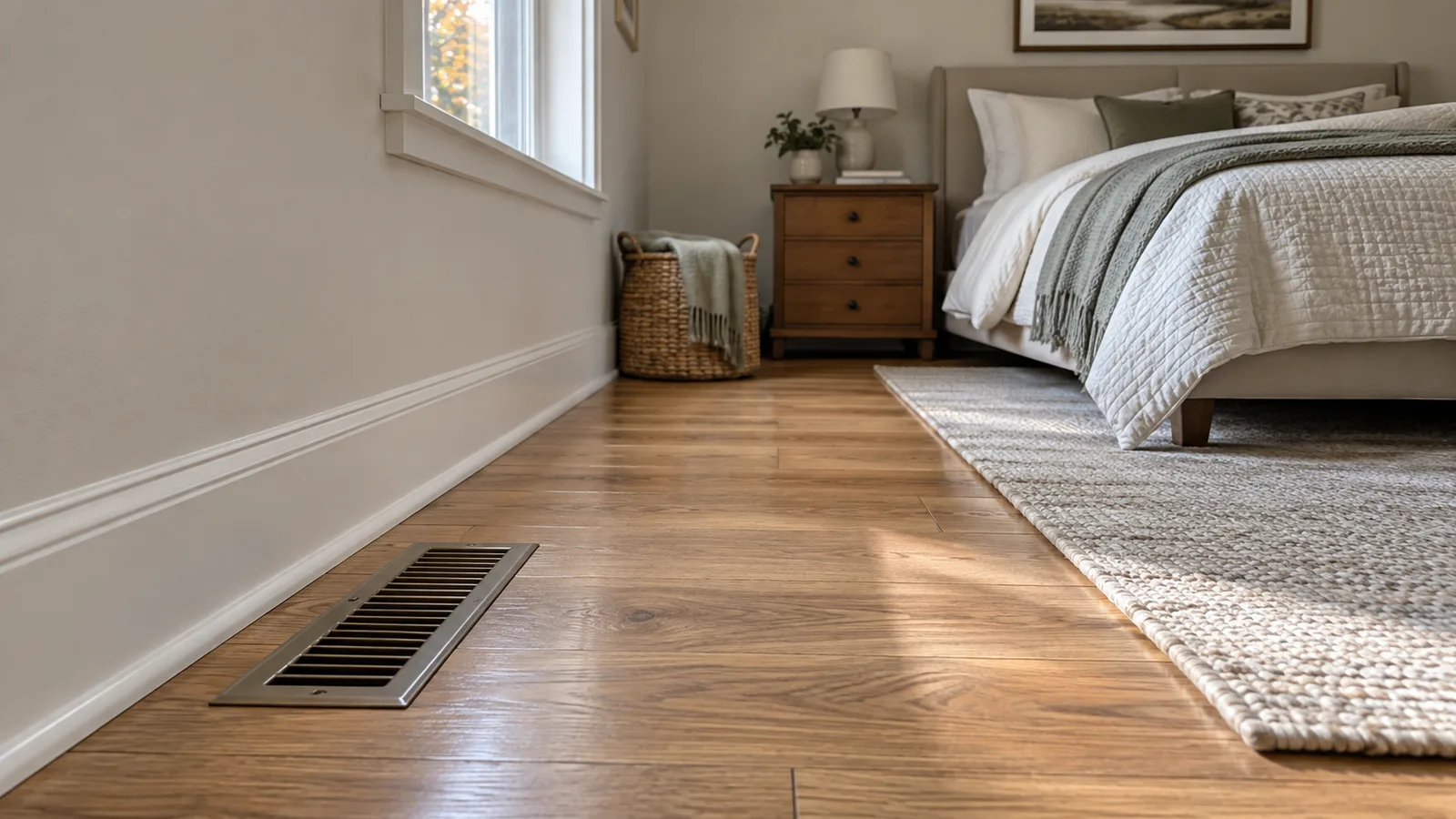
Quick answer: For a typical central forced-air heating system, do not close off unused rooms' supply vents as a do-it-yourself energy-saving strategy. Keep normal supply registers and return grilles unobstructed unless your HVAC professional has specified a balancing arrangement. Closing registers is not the same as operating a designed zoning system. If an empty bedroom is too warm or expensive to condition, ask about measured airflow, controls, and building-envelope improvements before buying vent covers.
This guide is for Westchester homeowners and property managers deciding what to do with a guest room, home office, or other lightly used space. It is general guidance, not a diagnosis of your furnace, heat pump, or ductwork.
First identify what actually heats the room
A floor or wall grille does not necessarily tell you which system supplies winter heat. Some homes have air-conditioning ducts plus a separate radiator or baseboard heating system. Before changing anything, identify the thermostat and equipment serving that room from your system documentation or a professional's explanation.
If warm air arrives through supply registers when the central heating runs, the forced-air discussion applies. A ducted heat pump also depends on an air-distribution system. A radiator valve, steam air vent, electric baseboard, and ductless indoor unit are different devices; do not treat them as interchangeable controls.
Write down what you know rather than experimenting with valves or breakers. “The bedroom has a floor grille and a radiator, and I do not know which heats it” is useful information for a service request. Never cover a radiator, baseboard heater, or equipment intake to imitate closing a duct register.
Why shutting a register is not a simple savings switch
Your thermostat typically asks the central system to satisfy the temperature where that thermostat senses conditions. Closing an outlet in another room does not automatically change the equipment's heating output or create a separate temperature-control zone.
A closed or obstructed register changes the resistance in the air-distribution path. Lennox's static-pressure guidance specifically warns that closing unused-room vents can increase static pressure and disrupt airflow. It recommends keeping supplies and returns clear and having pressure evaluated professionally.
That does not mean accidentally closing one register guarantees damage. Nor does it establish a universal safe number of vents to close. The result depends on the duct design, blower, equipment requirements, filter, and existing restrictions. Avoid rules such as “close half the vents” or “one room cannot matter.” A technician needs system-specific evidence before recommending an adjustment.
If a professional previously balanced the system and marked register or damper positions, preserve that arrangement and ask before changing it. This article is not an instruction to override a documented design.
Supply air and return air need different attention
Supply registers deliver conditioned air. Return grilles provide a route back toward the air handler. Do not cover a return with furniture, a bookcase, a rug, or a magnetic cover to keep a room warmer.
A closed bedroom door can also matter when the room has a supply register but relies on a central hallway return. Air needs a suitable path back; the gap beneath a door is not automatically adequate. The Building America Solution Center explains that inadequate return paths can create room pressure differences and comfort problems.
A professional may evaluate dedicated returns, transfer grilles, or jump ducts. These are design options, not a homeowner cutting project. Do not cut a door, wall, or fire-rated assembly to make an improvised return. Tell the evaluator whether the room is normally occupied with its door closed so testing represents real use.
For a rented office or shared building, bring the concern to the property manager before adjusting anything beyond your authorized controls.
A safe unused-room checklist
Use observations to describe the problem, without opening HVAC equipment or dismantling grilles.
1. Name the goal. Is the room too warm, too cold, noisy, or simply unoccupied? These are different problems. Record the outcome you want, such as keeping a guest bedroom comfortable without overheating the rest of the house. 2. Check for accidental obstructions. Look for furniture, rugs, curtains, storage boxes, or covers over normal supplies and returns. Move ordinary household objects away safely. Leave unfamiliar grilles and labeled professional adjustments alone. 3. Record temperatures consistently. Note the thermostat setting and the room temperature at the same times on a few ordinary days. Keep a room thermometer away from direct sun, the register's air stream, and exterior glass. Record observations rather than assuming a precise acceptable temperature difference. 4. Note door use. Write down whether discomfort occurs with the door open, closed, or either way. Do not compromise privacy, required fire-door operation, or your household's safety practices for an experiment. 5. Check maintenance records. Note when the filter was last serviced and what filter is installed. Follow the equipment's owner instructions for accessible routine filter care; do not remove equipment panels, add another filter, or run without the required filter. 6. Record the timing. Did the problem begin after new carpeting, furniture placement, a filter change, remodeling, or thermostat replacement? A date and a clear description are more helpful than guessing which component failed. 7. Stop at the observation boundary. Do not enter a tight crawlspace, climb into an attic, drill pressure-test holes, alter blower settings, or move duct dampers yourself.
The Department of Energy's home heating and cooling guide supports keeping vents clear, following owner maintenance instructions, and using professional inspections. For filter-selection questions, see our MERV 8, 11, and 13 guide; a higher rating is not automatically the right choice for every system.
Better questions than “How many vents can I close?”
Ask for an explanation of the finding and the proposed correction:
- Is the room receiving the intended airflow, and is there a suitable return path with its door in the normal position?
- Were pressure and airflow checked against this equipment's requirements?
- Is the problem local to one room, or does it affect the entire system?
- Could damaged, disconnected, or leaking ducts be contributing?
- Is the thermostat location or control setup influencing the complaint?
- What will be measured after the work to confirm the improvement?
ENERGY STAR's duct guidance identifies difficult-to-condition rooms and high heating or cooling bills as reasons to investigate duct performance. A room problem does not, by itself, prove that the furnace needs replacement.
A useful proposal should distinguish an airflow correction from a controls upgrade or building improvement. Request the scope, access requirements, and verification method in writing. Do not assume an equipment replacement automatically repairs an unresolved distribution problem.
When zoning or separate room control may help
If room use has permanently changed, describe the schedule: perhaps an office is used on weekdays while a guest room is occupied only occasionally. That gives the evaluator a real design objective.
Purpose-designed zoning coordinates controls and airflow; it is not simply a collection of closed registers. Lennox's air-balancing overview distinguishes professional measurement and balancing from basic vent adjustments and discusses zoning as a way to manage areas separately.
Ask whether your current equipment and ducts can support the proposed arrangement. A smart register is not proof of compatibility. The answer should account for operation when only a small area needs heating. Do not buy a package based only on the number of rooms it claims to control.
In some situations, a separate comfort solution may be worth evaluating. In others, repairing distribution or improving insulation is the more appropriate first step. There is no guaranteed payback or universal best upgrade without an assessment of the particular home.
Reduce waste without creating another problem
A rarely used room remains part of the building. Discuss an appropriate temperature strategy rather than deciding that it should receive no heat. Consider occupants, pets, plumbing, moisture, and the way neighboring rooms interact before making a substantial change.
For a heat pump, ask about the approved thermostat schedule and backup-heat controls rather than copying a furnace setback routine. Our AUX versus emergency heat guide explains why those settings deserve separate attention.
Drafts, insulation gaps, and window concerns should be evaluated as building issues, not hidden by shutting vents. If moisture is appearing on cold glass, use our window condensation guide to document the location and conditions. Neither a low bill nor a warmer hallway is a satisfactory result if another room develops an unresolved problem.
When to call for service
Arrange an evaluation if weak airflow, persistent room discomfort, unusual whistling, or repeated heating interruptions continue after obvious obstructions are removed. Describe the symptoms without treating them as proof of a specific defect. Do not repeatedly reset equipment or bypass a safety control.
If you suspect a gas leak, evacuate and call 911 or your utility from a safe location before requesting HVAC service. Follow Con Edison's gas-safety guidance. If a CO alarm sounds, move everyone to fresh air outside and call 911; do not stay inside searching for the source. Con Edison's CO guidance explains this emergency response.
Frequently asked questions
Can I close just one heating vent?
There is no universal number that is safe for every installation. Keep the normal airflow arrangement unless a qualified professional recommends a measured adjustment for your system. Accidentally closing one vent does not automatically mean damage occurred.
Should I close the return grille in an unused bedroom?
No. Do not obstruct the return-air path. If the room's purpose or layout has changed, have its supply and return arrangement evaluated instead of covering a grille.
Is closing a door the same as closing a vent?
No. A door affects the room's connection to the rest of the home, while a register affects a duct outlet. A closed door may still expose an inadequate return path. Tell the technician how the room is normally used.
Can a smart vent replace a zoning system?
Not automatically. Ask for equipment compatibility and airflow requirements to be checked before installation. A connected control does not remove the need for a suitable system design.
Does this advice apply to radiators?
Not directly. Radiators and baseboards use different heat-distribution and control arrangements. Ask for guidance specific to that equipment; do not apply duct-register advice to radiator valves or steam vents.
Get help with an uncomfortable Westchester room
Tell Bravo Mechanical which room is affected, what heats it, when the problem occurs, and whether anything changed recently. Request service for an evaluation, or explore our HVAC services. We can discuss the concern and appropriate next steps without assuming you need new equipment.
Request service or an estimate or call (914) 361-9142. Serving 34 listed communities in Westchester County, NY.